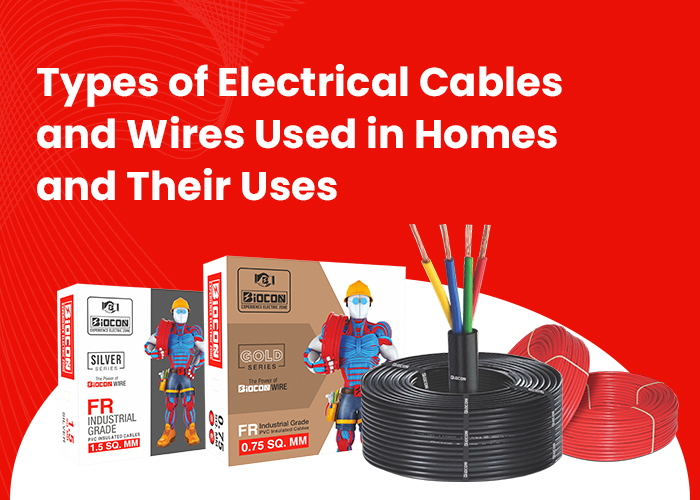
Types of Electrical Cables & Wires Used in Homes and Their Uses
All power systems at homes are anchored on electrical cables and wires. Whether it is lighting or appliances or safety devices the type of wire has a different purpose. The selection of the appropriate cable is not only a performance aspect that should be considered but also the safety consideration because wiring of low quality is among the most common causes of electrical fires in residential buildings. Below is a simple and understandable explanation on the most widely used electrical cables and wires in residential buildings and their application.
1. Single-Core Wires
One of the commonly used wires in the household electrical installation is single-core wires. These are made of one copper or aluminum conductor, which is coated with PVC insulation. These are wires that are mostly installed in conduits when wiring things that are fixed like switches, sockets and distribution boards.
The reason why they are preferred is that, they are easy to install, they are capable of bending in order to fit in the conduit systems, and they have good current carrying capacity. It is important that the insulation must be appropriate and that the thickness of wire used is correct in order to avoid overheating.
2. Multi-Core Cables
Multi-core cables are made up of two or more insulated conductors and they are covered by a single outer sheath. Appliances such as air conditioners, washing machines as well as water heaters are frequently connected using these cables.
Multi-core cables have the right advantage of neat wiring and extra protection since the many conductors are well packed together. They also minimise the chances of accidental damage as opposed to free floating individual wires.
3. Flexible Wires
Flexible wires consist of multi-strands of thin copper rather than a single strand of core-conductor. Such design makes them very flexible and can be used in portable devices like irons, mixers, extension cords, and table lamps.
The flexibility is needed since they are always moved or bent, and internal wire breakage can be prevented. Nevertheless, permanent concealed wiring is not to be done with flexible wires.
4. Armoured Cables
Armoured cables are applied in those areas where additional mechanical protection is required. These cables are made by wrapping the insulated conductors with a layer of metal which is most of the time steel. They can be used in homes either in underground connection, main supply lines or installed outside the homes.
They are very strong and can withstand any physical damage, moisture, and rodents hence they are applicable in harsh conditions.
5. Coaxial and Data Cables
Besides power cables, coaxial and data cables are also used in homes in the television, internet, and communication systems. These cables are specifically made to support signals that are less interfering.
They do not have any electrical power but good routing and insulation are nonetheless necessary to ensure quality and safety of the signals.
Conclusion
Knowledge of the various categories of electrical cables and wires can be used by the homeowner to make a considered decision, safety and the overall efficiency of the electric system. Starting with the single-core wiring of switch, to armoured cables to be used outside, both types have a purpose. To deliver dependable information and knowledge in electrical products and solutions, Biocon Electric tends to train the users on proper and safe electrical use and assist in quality-driven electrical infrastructures.